The Artist Within the Canvas: A Dialogue Across Time

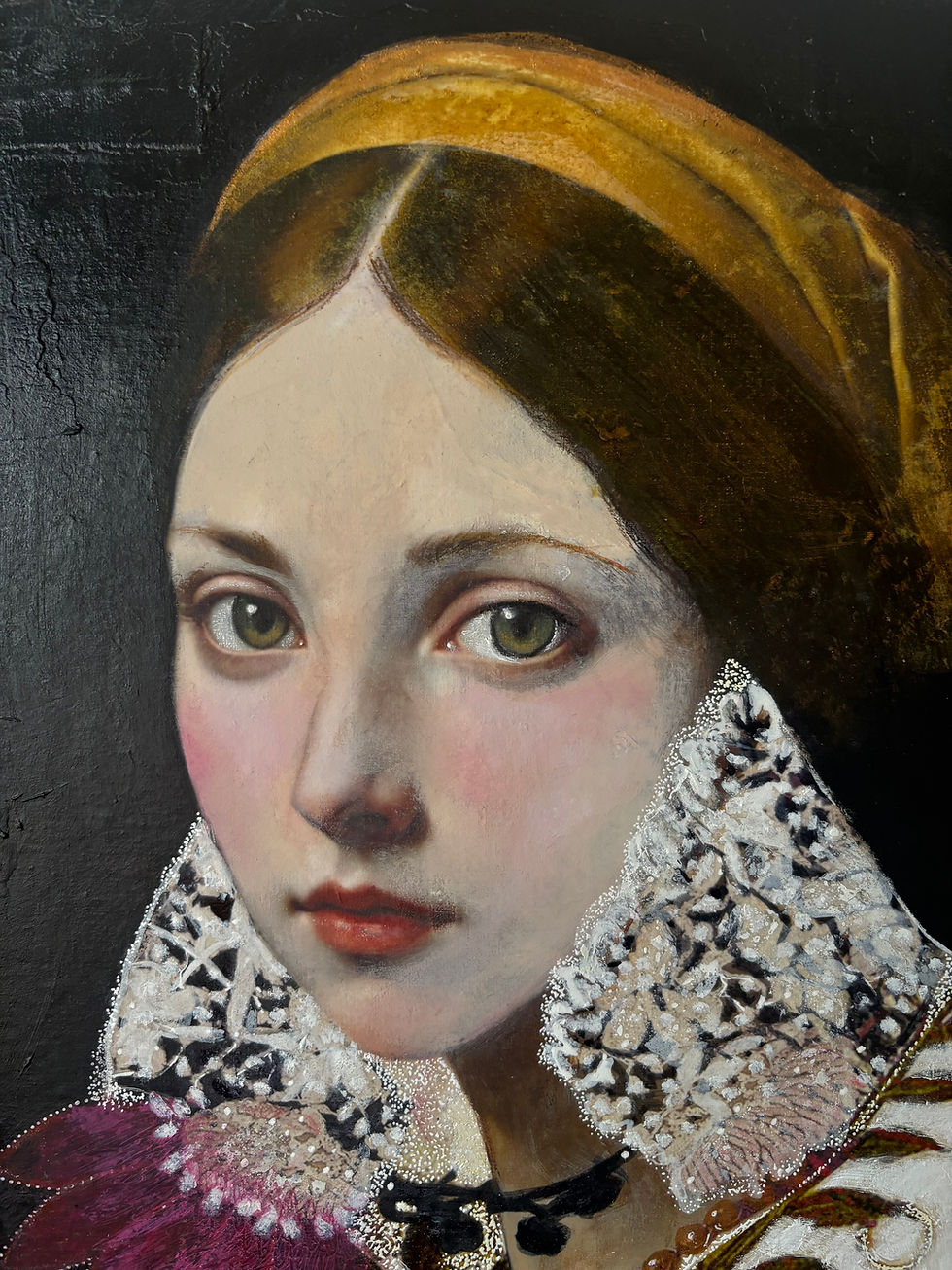
Awekening 03 
Awekening 05 
Awekening 01
There is a quiet, almost imperceptible intimacy between an artist and their work—one that cannot be fully explained, only felt.
Each piece carries within it more than gesture, composition, or technique; it holds a presence. It is not simply the result of a moment of creation, but the residue of a state of being.
When an artist paints, they do not only translate what they see—they reveal, often unconsciously, where they stand within their own life.
Every artwork becomes, in this sense, an imprint. Not just of a day, or a fleeting emotion, but of a broader inner landscape shaped by experiences, questions, desires, and uncertainties that define a particular period in time.
It is as though the painting itself becomes an X-ray—subtle yet precise—capturing layers of the artist that words could never fully articulate.
To revisit a piece created years ago is to encounter a former self. Not in a nostalgic or sentimental way, but in something far more profound. It is a recognition. A quiet acknowledgment of who one was at that moment—what was being processed, what was being felt, what was perhaps unresolved.
The work stands there unchanged, yet the artist has evolved. And in that contrast, something deeply moving emerges: a dialogue across time.
The technique may have transformed, refined by discipline and experience. The hand becomes more assured, the decisions more intentional.
But beyond technical evolution, there is something more essential at play. Each work belongs to a specific chapter of life, carrying its own emotional temperature, its own rhythm.
Some pieces feel raw, others contemplative, others expansive or restrained. Together, they form a living archive—not of perfection, but of becoming.
This is where the experience becomes almost startling. To stand before an earlier work is not unlike meeting a version of oneself that once lived fully, intensely, and truthfully in its own time.
That self no longer exists in the same way, yet it has not disappeared. It has been integrated, transformed, carried forward. The artwork becomes a point of access—a doorway through which that past presence can still be felt.
And this phenomenon extends beyond the artist.
When someone encounters a work of art and feels drawn to it—deeply, instinctively—it is rarely accidental. There is a resonance taking place. The artwork, created in a specific moment of the artist’s life, meets the viewer at a specific moment of theirs.
Something aligns. Perhaps it is a shared emotional frequency, a question unspoken, or a state of openness that allows the work to be received.
To acquire a piece of art is, in many ways, to mark a moment in one’s own life. It becomes intertwined with memory—not only of the object itself, but of the circumstances surrounding it.
Where one was, what one felt, why that particular work mattered among so many others. Over time, the piece remains, while the person continues to evolve. And yet, each time it is seen again, it carries the quiet ability to return its owner to that original encounter.
This is not unlike the way music can transport us instantly to another time, or how a scent—a flower, a perfume, a familiar dish—can dissolve the present and bring forth a vivid memory. In those moments, time loosens its structure. Past and present coexist. What once was does not feel distant; it feels immediate, alive.
There is something profoundly reassuring in this.
In a world often defined by speed, change, and constant movement, these experiences remind us of a different dimension of existence—one that is not bound by linear time.
They suggest that who we have been is not lost, but quietly held within us, evolving, transforming, yet always accessible.
For the artist, this awareness becomes a privilege. To witness one’s own life unfolding through the works created along the way is to see, with unusual clarity, the depth of that evolution. It reveals not only growth, but continuity.
Even in moments of doubt, fear, or uncertainty—those inevitable passages that shape every life—there is a thread that remains intact: the impulse to create, to express, to translate the intangible into form.
And perhaps this is where the true value of art resides.
Not solely in its visual presence, nor in its refinement, but in its ability to hold time, emotion, and human experience within a single surface. To exist as both object and memory.
To connect lives—those of the artist and the viewer—across different moments, different paths, yet within a shared sensitivity.
In this way, art gently reminds us of something essential: that we are always in movement, always becoming, and yet never entirely disconnected from who we once were.
And within that continuity, there is something quietly eternal—something to be recognized, cherished, and, above all, deeply felt.
.
.
.


Comments