Where a Painting Ends
- Karenina Fabrizzi
- Apr 14
- 3 min read

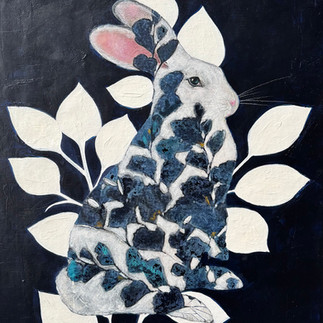


Sometimes artists deliberately move away from what is immediately pleasing.
Not out of rejection for beauty itself, but out of a need to go beyond it.
A work that is too comfortable can be absorbed quickly and forgotten just as fast.
By introducing tension—through composition, color, texture, or subject—the artist slows the viewer down. The piece resists being consumed at a glance. It asks for attention, and more importantly, it asks for reflection.
This kind of approach can feel like a form of quiet resistance. It challenges expectations, especially in environments where art is often treated as something decorative or easily digestible.
When a work creates a slight sense of discomfort or imbalance, it opens a different kind of dialogue. The viewer is no longer just observing; they are reacting, questioning, and sometimes even confronting their own assumptions or emotions through the work. That exchange becomes part of the piece itself.
The impact on the final artwork is significant. These choices shape not only how the work looks, but how it is experienced. A color that feels slightly off, a composition that refuses symmetry, or a texture that interrupts smoothness—all of these decisions create depth.
They introduce layers that are not immediately resolved. The work remains active over time, rather than offering a single, fixed impression.
At the same time, there is another challenge that runs parallel to this process: knowing when to stop.
This is one of the most difficult aspects of creating. It is rarely clear, and it cannot be reduced to a rule. Many artists experience the moment when a piece feels close to complete, but not entirely resolved. The temptation is to continue adjusting, adding, refining. However, there is a point where further intervention begins to weaken the work instead of strengthening it.
Overworking can erase the very qualities that gave the piece its presence. A gesture that once felt alive can become heavy. A balance that was subtle can become forced. What was initially intuitive turns into something overly controlled.
Recognizing that threshold—where the work holds enough tension, enough clarity, enough space—is essential. It is less about perfection and more about integrity.
This awareness develops over time, but it is never fully mastered. Each artwork brings its own set of conditions. Even when using similar materials or a familiar palette, the result is never the same. The tone shifts, the energy changes, and the emotional context is different every time. What worked in one piece does not necessarily apply to the next.
Each work exists within a specific moment. It carries the state of mind, the sensitivity, and the circumstances of the artist at that point in time.
That is part of what makes it singular. The variations are not just technical—they are emotional and perceptual.
Even subtle differences in color or application can reflect something deeper that cannot be repeated.
This is also why the idea of replication, whether through mass production or artificial systems, has its limits. While forms and styles can be imitated, the internal process behind a work cannot be duplicated in the same way.
The hesitation, the decision to stop, the awareness of what feels resolved—these are not mechanical steps. They are tied to experience and perception in a way that remains personal.
In the end, the strength of a piece often lies in both what is present and what has been left untouched. The balance between intention and restraint defines how the work holds itself over time. And that balance is different, every single time.
.
.
.


Comments