What If Happiness Was Your Main Job?

Work in progress 
Work in progress 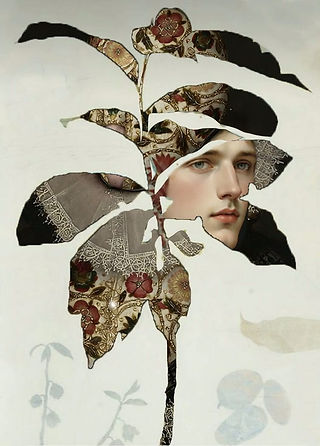
Work in progress
There are many things in life that remain almost invisible to us until they elevate their voice.
The wind is one of them, so What If Happiness Was Your Main Job?
Most days, it moves quietly around us, unnoticed. It brushes against the trees, enters through a half-open window, touches our skin for a second, and disappears without asking for recognition. We rarely stop to think about it. Yet when it becomes stronger, when it shakes the branches violently or pushes against our bodies, suddenly it occupies our entire attention. And in the opposite direction, when it arrives as a warm summer breeze carrying softness and calm, we notice it too.
We become aware of its presence because it has intensified enough to reach us emotionally.
I often think the same thing happens within our own bodies.
When everything functions perfectly, we barely acknowledge it. We wake up, walk, breathe, move our hands, see colors, listen to music, and carry ourselves through the day almost unconsciously. The miracle of the body becomes silent through repetition.
But the moment something hurts, a cut on the finger, a headache, a tension in the chest, that tiny discomfort suddenly becomes the center of our existence. It occupies the stage completely.
The rest of the body fades into the background as if it no longer exists.
And strangely, if another pain appears somewhere else, the first one loses importance almost instantly. Attention shifts.
The mind abandons one suffering to hold onto another.
I believe our thoughts and emotions behave in exactly the same way.
Human attention is deeply selective. The mind tends to follow familiar roads automatically, almost like a horse that already knows the path home. Left alone, it continues toward the same destination repeatedly, guided by habit, fear, memory, or conditioning. We often think we are consciously directing our thoughts, but many times we are simply being carried by old mental routes we have traveled thousands of times before.
Yet a horse can be trained.
With patience, softness, and repetition, it can learn new directions. It can respond to subtle guidance instead of instinct alone. And perhaps the mind is no different.
Perhaps our thoughts are not fixed landscapes, but living animals capable of being redirected.
The difficulty is that when we are facing a particular problem, our entire inner world tends to orbit around it. A fear, an insecurity, an emotional wound, a disappointment, suddenly it becomes the loudest thing in the room.
The mind returns to it compulsively, almost unable to focus elsewhere. But then life interrupts us. Another event occurs, another concern enters, another external reality demands attention, and unexpectedly our focus shifts again.
This reveals something profound: attention itself is movable.
And if attention can move unconsciously, perhaps it can also move consciously.
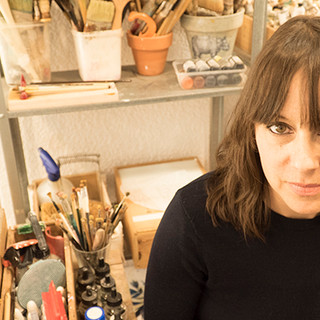
As an artist, I notice this pattern constantly in painting.
A canvas often begins with chaos. One brushstroke dominates too much. One color feels invasive. One mistake seems unbearable. For hours, all I can see is that single imbalance. Yet as the work evolves, new layers emerge. A darker tone softens the harshness.
A delicate line creates harmony. A translucent wash changes the emotional temperature of the entire piece. Suddenly, what once felt catastrophic becomes almost invisible within the whole composition.
Painting teaches me that focus changes reality.
A brushstroke alone can seem aggressive, but beside another color it becomes beautiful. A shadow can appear heavy until light is introduced nearby. In art, meaning is relational. Nothing exists completely on its own. And perhaps human emotions work similarly.
Suffering becomes absolute only when it occupies the entire canvas of our attention.
Humanity itself seems trapped in repetitive patterns. We revisit the same fears, conflicts, ambitions, comparisons, and emotional cycles over and over again, both individually and collectively. Sometimes it feels as though we only change direction when something dramatic forces us to. A storm. A loss. A crisis. A loud interruption powerful enough to shift the course of the horse.
But I wonder what would happen if we did not wait for pain to redirect us.
What if inner happiness became an active practice rather than an accidental consequence?
Not superficial happiness, but a conscious cultivation of peace, beauty, gratitude, presence, and emotional balance. What if every morning we approached our inner world the same way an artist approaches a blank canvas, intentionally, delicately, aware that each brushstroke matters?
Perhaps the world itself would begin to change.
Not through grand revolutions alone, but through millions of individual acts of inner alignment. Through people learning to guide their attention toward what nourishes rather than what destroys them.
Through becoming more aware of the invisible winds already surrounding us: beauty, silence, tenderness, sunlight, stillness, breath.
The things that whisper before they scream.
And maybe true wisdom is learning to notice them before they need to elevate their voice.
.
.
.



Comments