The Quiet Moment Before Becoming

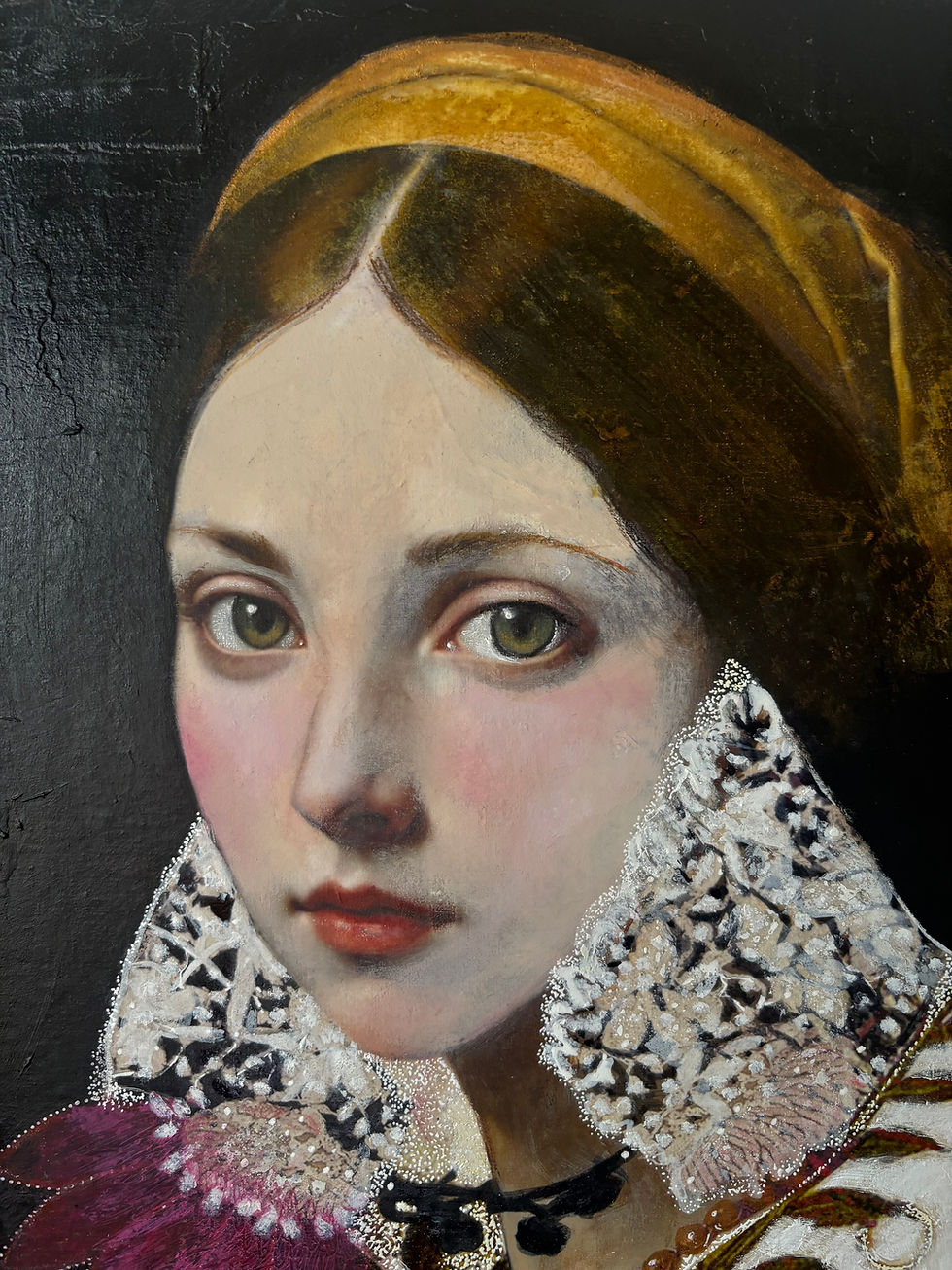
Feathered Memory II 
Feathered Memory II 
Feathered Memory II
There is a moment in every studio that resists description.
It arrives quietly, almost unnoticed, the instant before the first mark is made.
The canvas stands untouched, expansive and unresolved, holding within it an infinity of possible directions.
It is not empty, not really. It is full of potential, of tension, of silent invitation.
In that moment, something within us must decide.
Not always with clarity. Not always with certainty. Sometimes with nothing more than a subtle inclination, an instinct so delicate it could be mistaken for hesitation.
And yet, it is often enough.
A single color appears, almost unannounced. A gesture follows. And from that first movement, a path begins to unfold.
There are days when this unfolding feels effortless. The painting seems to know where it is going before we do.
Each brushstroke leads naturally to the next, as if guided by an intelligence beyond conscious thought.
In these moments, there is no resistance, only a quiet alignment. The hand moves, the eye responds, and something coherent begins to emerge. It is not forced. It is revealed.
And then, there are other days...
Days when nothing seems to settle. When each decision feels uncertain, when colors clash instead of converse, when the surface resists resolution.
These are the moments that test our patience, and perhaps more deeply, our trust.
It is tempting to believe that something has gone wrong—that the work is failing, or worse, that we are.
But perhaps this, too, is part of the process.
To stand before a painting that does not yet make sense is not so different from standing within a moment in life where clarity has not yet arrived.
We search for direction, for reassurance, for signs that we are moving “correctly.” And when they do not appear, the mind begins to construct narratives, often catastrophic ones.
We imagine the worst outcomes, the failed possibilities, the paths that lead nowhere.
The Stoics spoke of this tendency through the practice of premeditatio malorum, the contemplation of worst-case scenarios.
Not as a form of pessimism, but as a way of loosening fear’s grip.
Because when we truly consider what could go wrong, we often discover something unexpected: that even then, we would endure.
That even then, something within us would adapt, respond, continue.
In the studio, this realization can be quietly transformative.
When we release the need for the painting to resolve perfectly, something shifts.
The pressure dissolves. The work is no longer burdened by expectation, and in that space, it begins almost imperceptibly to breathe.
The colors start to speak again. Not loudly, not insistently, but enough to be heard if we are willing to listen.
And listening is, perhaps, the essence of it all.
Not imposing, not controlling, but entering into dialogue, with the material, with the moment, with something that cannot be fully named. There is a humility in this, and also a kind of freedom. Because the painting is no longer something we must conquer or complete, but something we accompany as it becomes.
Life, in its own way, asks for the same posture.
There are moments of flow, where everything aligns and moves with quiet precision. And there are moments of uncertainty, where direction feels obscured and decisions carry weight. In both, the impulse to control can become overwhelming.
We want guarantees, assurances, outcomes we can predict and secure.
But perhaps the deeper invitation is not to control, but to trust.
To trust that not everything needs to be resolved immediately.
That not every step must be justified before it is taken.
That, like the painting, life reveals itself gradually through attention, through presence, through a willingness to continue even without certainty.
And maybe this is where art and life meet most intimately: in the quiet courage to begin without knowing, to continue without certainty, and to trust that, in time, what once felt uncertain will reveal its own quiet coherence.
.
.
.


Comments